
Activities
CONTENTS
Book and Learning Material Exchange Model of FAIE.
For students, purchasing books and reference materials requires a considerable amount of expense. In order to deepen knowledge or participate in scientific research, access to a rich source of materials is essential. To address this issue, students from different cohorts often organize book exchange activities at the beginning of each semester in various forms and scales.
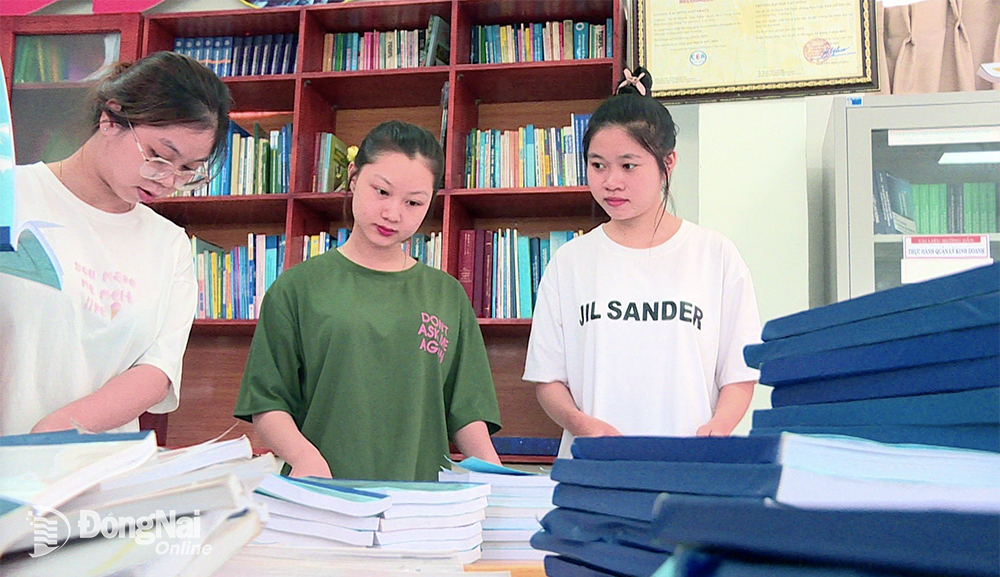
This activity enables students to proactively search for and exchange materials before starting a new semester. It is also an opportunity for young people to interact and learn from one another.
-
Sharing materials, saving costs
The book exchange program not only helps students save costs but also provides access to a diverse range of materials to better support their studies.
Book and reference material exchange activities take place at most universities in various forms and scales, primarily as spontaneous initiatives by students. Accessing and exchanging information is quite convenient thanks to Facebook pages.
At Lac Hong University, the book exchange program has been organized regularly over the past three years by The Faculty of Administration International Economics. Originating from the initial idea of Ms. Ta Thi Thanh Huong, through book exchanges within the subjects and classes she was responsible for, the activity received enthusiastic support from students. Therefore, The Faculty of Administration International Economics decided to expand the model and implement it periodically at the beginning of each semester.
Accordingly, at the end of each semester, students submit the materials and textbooks they have used and exchange them for materials they wish to obtain or need for upcoming courses. After multiple implementations, the student book exchange program has become an experiential initiative, reported at the university level, presented at the provincial level, and officially recognized.
Mr. Nguyen Vu Minh Quy, a student of Economic Law, shared: “I exchanged books by contributing my old books to the program and selecting the books I needed in return. This is a very meaningful program for students.”
Ms. Ha Thi Thuan, a student of Business Administration, has participated in the book exchange program twice. She has also actively encouraged her friends to join the program. She believes that, in addition to helping students save costs on books and reference materials, the program also strengthens connections among students from different cohorts.
-
Better serving learners
Along with exchanging books, materials, and textbooks, The Faculty of Administration International Economics also regularly updates new materials for the faculty library. Currently, the faculty library has three areas: one for undergraduate students, one for master’s students, and one for doctoral candidates.
PhD Nguyen Van Tan, Dean of The Faculty of Administration International Economics, Lac Hong University, stated: “Our faculty offers Business Administration programs at the undergraduate, master’s, and doctoral levels. To support students with learning materials, the faculty has organized three such areas for convenience, and students are very enthusiastic.”
Thanks to the book exchange program, students not only save significant costs on purchasing materials and textbooks but also find it more convenient to access materials for study and scientific research. At the same time, the program has fostered a sense of social responsibility among students. In addition to donating books, many graduates have also donated learning tools and old computers to subsequent cohorts.
“This is an opportunity for us to create an environment where students can contribute and demonstrate greater social responsibility. Therefore, the faculty will continue to maintain the program and hopes to further improve it in the coming years,” PhD Nguyen Van Tan added.
